Buying Art
Smart Investment, or AN EXTRAVAGANT Passion?
The Market. The Myth. The Pitfalls. The Fluff.
My dear Friends,
You’ve probably noticed it too: buying art is not only super en vogue, but it also comes with price tags to match. Prices have been climbing for years, as if art were immune to economic logic and buying art was somehow elevated to smart-investment status by default. Andy Warhol’s Shot Sage Blue Marilyn sold for $195 million, making it the second most expensive piece ever auctioned. The record-holder, Salvator Mundi, attributed to Leonardo da Vinci despite persistent doubts about its origin, fetched a staggering $430.5 million. Even Frida Kahlo’s work, once dismissed as too emotional, reached $34.5 million—an amount she could never have imagined in her lifetime.
But record prices do not mean the whole art market is on an infinite upward trajectory. In 2022, the art market took a hit alongside the stock market and crypto crash—favourites like Basquiat, Banksy, or Beeple took a severe hit.
So, do art markets move in sync with stock markets? Seemingly not. Warhols, Monets and Picassos fetched higher prices than ever before.
Buying art is certainly a sophisticated pastime, seemingly only accessible to insiders, the jet-set or by invitation from an insider. Art markets are and always will be a mystery, with many deals made in obscurity. Access is difficult, transparency is lacking, and the market has plenty of black sheep and a crime rate to match. Is the astronomical price tag for a work of art a prerequisite for its suitability as an alternative portfolio asset? Certainly, a well-filled coffer helps, and connections to insiders are mandatory to gain access.
But before we conflate the art market show with market reality, it is worth asking how to buy art, and what the criteria are to make art into a portfolio asset
How It All Began
The origins of collecting can be traced back to the ancient civilizations of Egypt, Babylonia, China, and India. Frequently these objects, accumulated in temples, were used to display the glory of a ruler and religion.
During the Renaissance Period, commissioning artworks or having a great collection was directly connected to the patron´s social status, erudition, and taste. During this time, the artists also obtained a higher status and fame.
For the last two-hundred years, the practice of collecting art has grown to unimaginable heights. As time has gone by, the art world has gotten more complex. Motivations behind collecting have oscillated between the love of art and a well-thought-out investment strategy for the future.
Over the last few decades, the art community has evolved into a machine that encompasses art dealers, art fairs, galleries, art advisors, artists, and many others, all aimed at helping collectors acquire the right piece at the right price. Importantly, the technological tools available have also brought immediacy to the process of acquiring new pieces. Not to mention globalisation’s effect on introducing collectors to otherwise inaccessible artists. Yet buying art as a smart investment still requires more than access, desire, and a persuasive art dealer. Buying art may now be easier; making it a smart investment remains a challenge.
The passionate collector
Usually, genuine art lovers start collecting artwork for aesthetic reasons. Others only seek to accumulate possessions no one else has. For art collectors, both of these reasons are true, but there are several specific reasons are lovers choose to collect art:
- support the arts
- be part of a community
- preserve history
- experience the thrill
- decorate their homes
- reveal their personality
- tell a story
- pass on a legacy
Buying art for the collector is deeply personal, long before it is considered an investment. A collection may begin with curiosity, conviction, status, memory, or the simple pleasure of ownership. Yet the moment art moves beyond decorative purposes, another question quickly arises: is buying art reserved for those with serious money, or can it become a smart investment for more than the usual few?
For the uber-wealthy only?
Many still associate art collecting with the ultra-wealthy, imagining auction rooms full of giddy people making million-dollar bids to realise huge resale profits. In reality, serious collectors usually know what they want long before the auction begins, and a serious due diligence is done at private previews. Buying art is rarely a quick-profit game; art only becomes a smart investment if passion and due diligence are balanced, and the financial means to keep a piece of art for a long, long time .
Buying a work of art outright is, of course, a legitimate option for those with substantial capital. But serious buyers, whether experienced or a novice, rarely spend significant sums on impulse. Before an auction or art fair, they either conduct due diligence themselves or rely on trusted experts. Think five, six, seven, or even eight figures.
However, there is some wiggle room and plenty of opportunity for those with less petty cash to throw out of the window. A Picasso plate is yours for $5,000, whereas an oil painting of one of his mistresses is more like $155 million.
It is a widespread myth that you need millions to start an art collection, and becoming a serious collector is an unreachable dream. Nor does buying art begin with writing a seven-figure check at an auction or at one of the hyped art fairs. With sound knowledge of art history, a long-term view, and market information, even a small initial purchase can become the start of an impressive collection and a smart investment.
Like the stock market, the art market has become a lot more democratised. Similar to the financial industry, where Fintechs are adopting available tools and platform technologies to lower barriers, the art industry is adopting these tools and technologies to ease market accessibility. Recent market trends allow a whole new generation of collectors to start their art collections.
The new collector generation
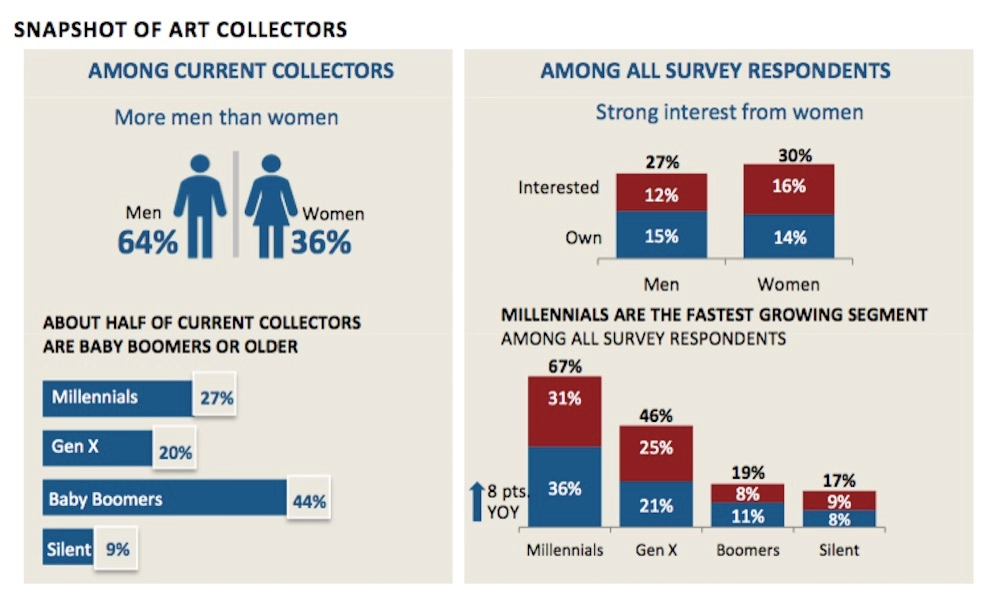
Baby boomers are still the dominant generation of art collectors, comprising about half of all current collectors. However, millennials are the fastest-growing segment.
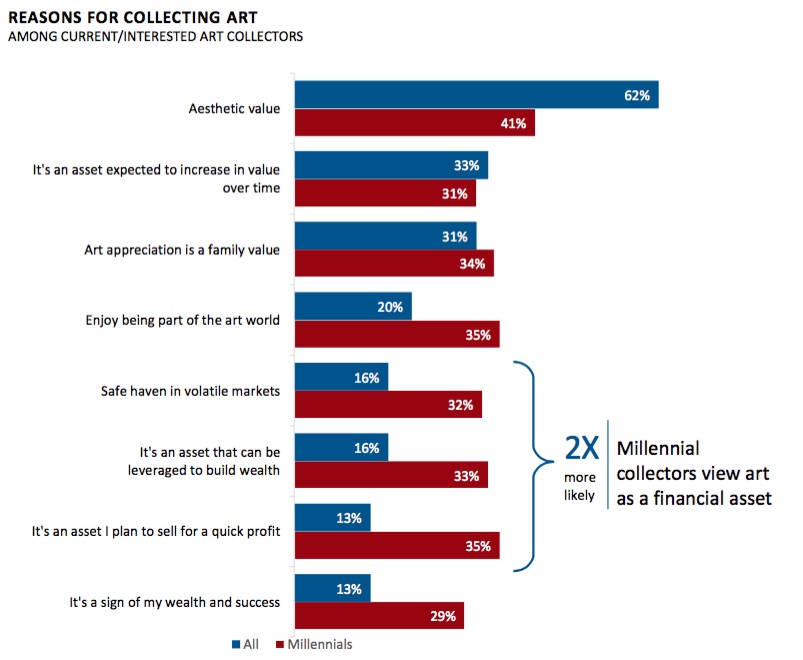
While aesthetic enjoyment continues to be the primary reason for collecting art, “a generational shift is now underway.” Younger collectors tend to be more financially driven and attuned to art’s role as a smart investment. A third of millennial collectors view their art as a smart investment and a financial asset to leverage for greater wealth. The same survey found that this new generation of aspiring collectors is also drawn to the social aspects of collecting, such as engaging with other collectors and artists.
The survey also showed a considerable uptick in buying art online. Women were the biggest drivers of the growth in online acquisitions, which may be partly attributed to the “rise of the digital channel for decorative arts in particular,” according to the survey.
While male collectors still largely dominate the traditional art market, women are an undeniably growing force. One in three high-net-worth women either owns art (14 %) or is interested in collecting (16 %), with interest among women higher than men.
Buying art online may have made the market feel more immediate and approachable, but easy access does not guarantee smart investment decisions. The new collector generation still needs to employ the same old-fashioned process of due diligence: context, origin, provenance, seller, expertise, and a healthy suspicion of the overly eager salesperson.
Investment Or Infatuation- Does It Really Pay Off?
Investing in artwork can feel more like a dice roll than an investment. However, thanks to widely publicised auction sales and fancy art fairs, painting and sculpture collectors have generated significant buzz around the art market over the years.
Art Basel and UBS Global Art report show the global art boom is no passing fad. It seems beauty doesn’t exist solely in the eyes of the beholder — markets stake an objective claim to its value. So, it is true that buying art can generate net serious returns. But beware, there are risks and drawbacks.
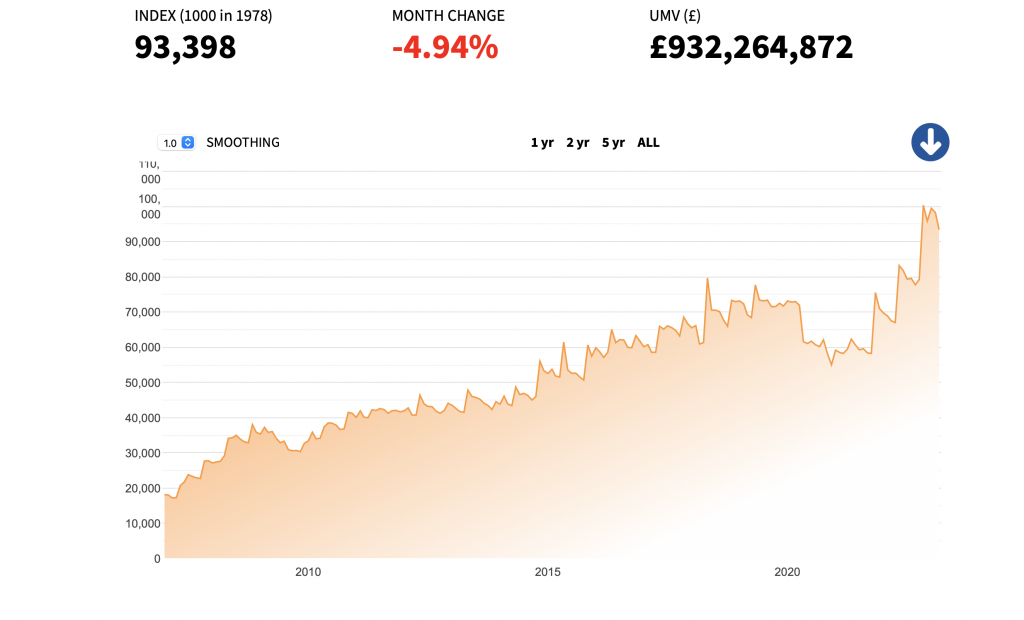
Still, buying art is a super smart investment because it tends to hold its value and often increases steadily over time. Compared to stocks or other investments, art fluctuates less.
The art market is not highly correlated with the stock or bond markets. That’s exactly what investors are looking for when diversifying their assets. No matter what the financial markets are doing – moving up or trending down – the art market tends to act independently and is often considered a safe haven during periods of high inflation.
Fact is, while both stocks and bonds were declining in the first half of 2022, art auctions were setting new record prices.
Due dilligence
However, as an investor, you must remember that art is a highly illiquid asset class. It can take years for a piece of art to sell at auction. Buyers/Collectors need to consider that buying art is a medium- to long-term addition to your portfolio, only then does the acquisition of art become a smart investment.
Remember, as with any financial investment, extensive research is a must. If in doubt, speak to a curator or art market consultant. Overall, art investing is hard work. For an artwork to generate significant returns, the buyer must consider the artist’s overall influence beyond media praise and public recognition.
Successful art purchases are the product of diligent planning and thorough research of the art’s historical and cultural significance. But this is exactly what makes art a great investment: with proper due diligence, just as you do with any other investment, art is a solid way to diversify your portfolio, and having a variety of assets helps minimise risk.
Bare Basics
The art community is a machine that encompasses art dealers, art fairs, galleries, art advisors, artists, and many dubious players
Buying art for the collector is deeply personal, long before it is considered an investment
By selling art online the market is more accessible
The art market is NOT correlated with the stock or bond markets
Art is a highly illiquid asset class
Successful art purchases are the product of diligent planning and thorough research
Art-market indices can help collectors and owners better understand this asset class
Treat your art purchases like alternative investments. As if you were purchasing stock or other securities
Art is a long-term investment
Art funds are structured much like other investment funds–investors can partially own pieces of art
Art Shares are similar to financial market shares; investors buy a share in one specific piece of art
Art finance is a tool for borrowing against the existing collections; a minimum value of a collection is required
NFTs are digital art investments that made serious money during the COVID-19 lockdown
Non-Fungible Tokens (NFTs) have lost their lustre since 2021. The bull run is over
Art Investing For Beginners-A Short Guide
The first and most important rule, as with any other investment, is to dedicate several months to passive observation of art auction news and valuation trends. As a rule, the works of prolific living artists are appraised at a value lower than those of a deceased master artist with a finite number of works attributed to them.
Smart investing
To make smart investment decisions in buying art, you have to nail the basics. Treat your art purchases like alternative investments. As if you were purchasing stock or other securities. Refrain from using your gut feeling, personal preference, or taste; these are certainly the wrong tools for making any smart investment decisions in whatever market, so why concede when buying art?
- be passionate about art
- set a goal
- do research
- join a community
- seek expert help
- decide on your budget
- make informed decisions
- be wary of the risks
Invest in art when prices are low. That usually means the earlier an artist is in their career, the more affordable they will be. Various art market indexes give a good guideline on the development of artists. Investing in “emerging artists”, however, also bears higher risk.
To be on the safe side, you could invest in “an established artist or “a mid-career artist. The drawback is the considerably higher price. These artists have already succeeded in the art markets. They have sold at auction houses, with consistent returns on investments.
There is also the category of “blue chip” art. These are the biggest names in the art world and are truly low-risk investments. These works hang in the most prestigious museums the drawback, however, is the hefty upfront investment.
Vital tool: The art market indices
Art-market indices can help collectors and owners better understand this asset class. Making a smart investment is both an art and a science. Improvements in data science make art indices a more viable tool for understanding trends in art markets.
Art indexes do have their limitations, to be sure. Art is a large, heterogeneous, unregulated market in which more than half of all sales are private. The unique qualities of a work of art, including its provenance and condition, affect individual prices. Additionally, ever-changing tastes greatly influence valuations. What’s more, most art indices don’t include work that fails to sell.
These benchmarks improve continuously and are increasingly helping collectors understand the value of what they own. Thus, being able to identify pricing trends and make better decisions about owning and planning around their art.
The extra costs
Art is typically a tangible, hard asset. Unlike intangible assets such as retirement accounts, art takes up physical space. Care and maintenance are required to ensure that the art retains its value. If you’re displaying the art in your home, you’ll need to be mindful of the temperature, humidity, sunlight, and other factors that could degrade the work.
Also, bear in mind that there are various other costs to consider when purchasing and selling artwork. Nitty gritty like sales tax, transportation expenses, authentication and appraisal fees, and insurance of course
Finally, art is a long-term investment, and while the art market can be stable or show large returns on investment during boom times, it can, just like any other asset, plummet in value during seasons of recession.
Importantly, if you’re going to buy individual works of art, you probably want to buy works that make you happy. If you invest $10,000 in a painting you think is ugly just because you expect its value to rise, you’re missing out on the excitement of buying art. Worse, if you are not even an art lover and are buying art only for investment purposes, you probably make fewer truly smart investments. Becoming a collector is passion, being levelheaded and market insight in an equilibrium
Beware of the con-artist
The most problematic thing in the art world is the people. Plenty of inflated egos among artists, collectors and well-known figures from “the industry” and the art business. Fake people are everywhere, but the art world is full of impostors, fakes and con-artists. They have been deceiving people for decades. With fake paintings, fake social status or a fake celebrity.
From Anna Delvy and Wolfgang Beltracchi to Inigo Philbrick. The first was a fake heiress defrauding investors. The second was an art forger who made millions by faking other artists’ paintings. The latter defrauded art investors with a Ponzi-like scheme. The art market is the swindler most favourite playground.
Seemingly endless fraud lawsuits swamp the art world. Charges range from art trafficking and selling fakes to fraud and money laundering. Many con artists enjoy the high life at the top of the market for years until they finally get caught.
Over the years, art fairs have become more of a social event, oozing FOMO. From Art Basel and Art Miami to the ever-expanding circuit of biennales and triennales, the art world has become a travelling playground for the rich and beautiful, the models, footballers, fashion designers, CEOs, company owners, heiresses, and all the wannabees in between. Some arrive to buy. More arrive to be seen. Others arrive hoping to brush against a celebrity, acquire a more useful social circle, or find the dream husband while sipping champagne at an art dealer’s booth. Around them, the same crowd moves from one fair to the next in a perpetual cocktail party dressed as cultural relevance. Serious collectors, meanwhile, are often found elsewhere: at private previews, in trusted galleries, at a collector friend’s home, or following a discreet tip to view a long-lost piece of art.
Art investing for small budgets
Buying art, or art investment, is no longer limited to the uber-rich. If you’re interested in art and don’t want the hassle of owning a piece, or if you lack the funds to buy blue-chip art. You can still make a smart investment in artwork that fits your budget.
Just as robo-advisors have helped to democratize access to financial advice and portfolio-based investing, there are platforms that allow investors who aren’t filthy rich to own a share of artwork. All for only a few hundred or a few thousand dollars.
By and large, art investment platforms work in fairly similar ways. Some buy individual artwork themselves, then create and list shares that other investors can buy. They make money by charging a fee for managing the process and storing and insuring the art on investors’ behalf.
Art funds
Art funds, are structured much like other investment funds, allow investors to partially own pieces of art. The fund usually creates a holding company for each piece of art to acquire. The art fund´s manager acquires blue-chip artwork at auctions on behalf of the fund’s investors. The fund stores, promotes, and resells this blue-chip artwork for a profit. Funds have to register and comply with a country’s law for investment funds, just like any other financial market fund.
Bear in mind that investors don’t get to take physical possession of the art. You are either buying a fractional interest in a tangible painting or investing in a collectables fund that holds several pieces of art. Pretty much the same principle as in alternative asset investing. The risks of a total loss are considerably lower. For one, the fund manager will not be guided by passion or emotion but by market insight, knowledge and numbers; second, less money is required for purchase and maintenance, and further, the likelihood of an advantageous exit is considerably higher.
Here are some of the best-known Art Funds, but over time, there will be more to be found, so careful research into particular funds is mandatory – otherwise the likelihood of making a not so smart investment will rise exponentially.
As with any other fund, factors like fees, market insight, provenance, fund strategy, regulation, and the manager’s expert understanding of art and investment savvy are crucial for an art asset to become a truly smart investment. Over time, there will be more funds, so careful research into a particular fund is mandatory – otherwise, the likelihood of making a not-so-smart investment will rise exponentially.
Arte shares
Art shares are exactly what they sound like: instead of buying the whole artwork, investors buy a share in one specific piece. The entry price is lower, which makes the idea rather tempting. You are not buying the painting for your wall; you are buying exposure to its possible future value. Very modern. Very clever. Still very much requiring vigilance.
If there are willing buyers for your share, you may be able to sell before the artwork itself is sold. That can make art shares feel more flexible than a traditional art fund. But flexible does not mean risk-free. The value still depends on demand, timing, fees, the company´s business model, and whether the art market remains interested when you decide to exit.
Art stocks are different. Here, you are not buying a slice of a painting or sculpture. You are investing in a company connected to the art industry. That could be an auction house, an online art marketplace, a specialist storage or logistics business, or a company helping collectors and galleries finance purchases.
In other words, you do not own the artwork. You own a stake in the company’s revenue, growth, and profitability. Less romance, more balance sheet. Possibly less dinner conversation, but considerably easier to price.
Art stocks sit much closer to traditional equities. They may be listed on exchanges, subject to regulation, and traded by the same market forces that move other public companies. Compared with physical art, they can offer more liquidity, regulation, and price transparency.
The art industry clearly has investment potential, but art stocks come with their own risk profile. This is a niche sector with limited options, uneven market exposure, and very specific dynamics. So yes, art stocks can be interesting. But interesting is not the same as a smart investment decision, and as a niche investment, it still needs more than a seductive industry label.
Art finance
As much as you can borrow money for buying art, The first option finances the purchase of a specific piece, usually with repayment over a defined period. The latter uses your existing collection as collateral, allowing you to access liquidity without having to sell.
Naturally, nobody hands over money just because a painting looks important and someone once nodded at an auction. The collection is first valued by experts based on the current market, provenance, condition, demand, and the artist’s future prospects. Lenders usually advance only a percentage of the assessed value, often up to around 50%, because even banks prefer not to confuse enthusiasm with security.
Whether you keep possession of the work depends on the lender, the country, and the agreement. Sometimes the art can remain with the owner, often under strict conditions of insurance, storage, and inspection. In other cases, the lender may require the work to be held in specialist storage until the loan is repaid.
Borrowers can use this liquidity to buy another piece of art, purchase real estate, invest in a business venture, or do whatever they have in mind. The required collection value is rarely modest: art-backed lending usually starts with collections worth around $1 million and can extend well beyond $20 million min. requirement.
The lenders are typically private banks, the private banking divisions of major international banks, specialist finance institutions, and the finance departments of large auction houses such as Sotheby’s and Christie’s. Depending on a country´s financial regulations. The risks? Valuation volatility, fees, interest rates, changing market demand, and local regulation. In some countries, particularly in Europe, borrowing against art comes with serious legal hurdles.
This is where buying art becomes a financial instrument subject to fiscal regulations. So, buying art can support a smart investment strategy – as a hedge for inflation or a stock market crash, but only when in-depth research has been done, and consequences are understood before a substantial money transfer has happened.
The New Type of Art Investment
In 2021 a new type of art and investment emerged into the art world. Christie’s record sale of Beeple’s Everyday: the First 5000 Days NFT for $69 million. It was easy to make money in the ultra-hyped NFT market. People were locked up, bored, and had a lot of money available. But that was not all. Big auction houses like Christie’s and Sotheby’s went online, and the Metaverse was born.
It was a simple online procedure. Invest via a platform in a new token and watch your investment grow as demand for the token increases.
NFTs (non-fungible tokens) can represent ownership in almost anything, from digital art to virtual real estate. Contrary to Bitcoin or dollars, NFTs are described as Non-Fungible because each one is unique and has its own value.
Today non-Fungible Tokens (NFTs) have clearly lost the lustre they had in early 2021. The bull run is over, liquidity has evaporated, and trade volumes have tanked. OpenSea, an NFT trading platform, experienced a drop of more than 90% between January and August 2022. The market was clearly inflated, and the NFT bubble had to burst sooner or later. Reports also suggest that the NFT market was severely affected by the collapse of the cryptocurrency industry. The NFT market tanked from $17 billion in January 2022 to $466 million in September of the same year.
The NFT Investor
“The NFT Investor” does not exist; there is no specific trait NFT Investors have in common. During the boom, the crowd included crypto-native millennials, tech people, digital creatives, self-made entrepreneurs, curious collectors, and a fair number who feared the future had opened a gate to fast riches and that nobody told them.
Seasoned collector-investors from the traditional art market were far more cautious. Many stayed away from buying NFTs altogether, not least because artistic relevance and long-term value looked rather harder to judge than the noise suggested. Some internationally known auction houses, however, did jump on the bandwagon, but often less out of deep conviction for the art form and more because hype can be super profitable. And profits they made!
Too many strongly believed that NFTs were visionary and would democratise the art market. Similarly to the financial market, with the introduction of roboadvisors and trade platforms. Nobody understood the clever marketing behind the hype. Some understood assets, scarcity, and speculation. Others had enough curiosity, plenty of appetite, and the slightly dangerous confidence that tends to appear when everyone else seems to be getting rich super fast by merely a click. They understood momentum, community, and the giddiness of not wanting to miss the next big thing. Was it all FOMO? Not entirely. But FOMO, with the extensive help of social media, certainly played a big role.
Whether NFTs merely suffered a brutal market correction, pretty much like the crypto market, remains to be seen. Maybe the market will recover, just with fewer hyped-up prices and fewer FOMO-driven buyers. NFTs are a useful reminder that not every new type of art investment is visionary simply because it arrives with technology and a confident price tag.
Verdict: Good for diversification, but with risks
Art can be a smart investment for anyone looking to diversify their portfolio. As with any other investment, buying art needs a goal and informed decisions. Otherwise, it remains a hobby with the possibility of a positive financial outcome.
Always remember: Art is a long-term addition to a portfolio and a highly illiquid investment.
Thanks for reading the whole letter before I end, a final note:
Financial confidence isn’t about knowing all the answers, but about being willing to ask better questions.
–yours Harper
SOURCES: TATLER; MORGANSTANLEY;THE ART NEWSPAPER; FORBES; VIENNA CONTEMPORARY MAGAZINE; THE HELM; ARTSY.NET; MASTERWORKS; CNBC; BBC; MANAGER MAGAZINE; ARTELIER; DELOITTE; MOTLEY FOOL; MYARTBROKER; ECONOMIST