The US Debt Ceiling Crisis
Could It Impact Smart Investment Decisions?
Know the facts. Use investment intelligence. Ignore theatrical headlines. Avoid decision-making paralysis.
My dear Friends,
not to worry, I shall resist the temptation to become alarmist, although the financial headlines are currently behaving as though civilisation may end sometime before aperitivo. The stakes are admittedly rather high right now, and the US Debt Ceiling Crisis is once again dominating financial news cycles and investor conversations alike.
According to current estimates, the United States could run out of money by 1st, of June. Then again, this is hardly a new performance. The US has already reached its debt ceiling 78 times before, usually accompanied by theatrical headlines, political brinkmanship, and increasingly anxious television commentators.
So far, the US has reached its debt ceiling 78 times and will probably continue to do so. Always accompanied by panic-mongering. Yet, previous debt ceiling crises were resolved at the 11th hour, and life went on as before–markets recovered, and investors calmed down,
Still, the uncomfortable question remains: could this latest political drama genuinely impact smart investment decisions and global financial markets? And perhaps more importantly, what happens to the global economy and investors should the political theatre finally fail to produce an agreement?
Sounds super boring? Please, hang in there for a few minutes because this is important.
What Is A Debt Ceiling Anyway?
If the US government hits the debt ceiling and exhausts all other options, it can no longer borrow money from markets. Meaning it will run out of money soon after it hits the limit, temporarily defaulting on obligations.
Let’s take a look at what the debt ceiling is all about. The Department of the Treasury says:
The debt limit is the total amount of money that the United States government is authoriZed to borrow to meet its existing legal obligations, including Social Security and Medicare benefits, military salaries, interest on the national debt, tax refunds, and other payments. The debt limit does not authorise new spending commitments. It simply allows the government to finance existing legal obligations that Congress and presidents of both parties have made in the past.”
If the Treasury Department is not able to borrow additional money, the United States could default on outstanding loans. Credit rating groups may downgrade U.S. credit ratings as a consequence. Additionally, a default would negatively impact the U.S. economy and international financial markets.
Congress, Treasury and Household Bookkeeping
The debt ceiling was introduced at a time when Congress was far more involved in the practical business of borrowing money. In those days, whenever the Treasury needed funds, Congress had to approve the borrowing almost project by project. Yes, imagine politicians voluntarily discussing financial details for hours on end. Exhausting.
Congress had to authorise the Treasury to issue bonds to finance the construction of the Panama Canal under the Panama Canal Act. Other projects came with their own taxes or separate bond issuances, and the Treasury had to keep all those different piles of money carefully separated. Financial administration was less “global market superpower” and more “complicated household bookkeeping with impressive buildings attached.”
The real turning point came in 1917 when the United States entered World War I and suddenly needed vast amounts of money very quickly. Treasury had to keep asking Congress for permission whenever more borrowing was required to finance the war effort, which became highly impractical rather fast.
So Congress simplified the process under the Second Liberty Bond Act. The Treasury was allowed to issue bonds without needing approval each time, but with one important condition: a borrowing limit was introduced to prevent spending from drifting entirely out of control. Over time, that limit evolved into today’s debt ceiling.
In practice, the Treasury can decide how and when debt is issued, while Congress controls spending through the federal budget. The debt ceiling simply caps how much the government is allowed to borrow to pay for obligations already approved. The original idea was actually rather sensible: force politicians to occasionally pause and think about government spending before matters spiral completely out of hand..
Whether that system still works as intended is, of course, another question entirely—and one that sits at the centre of every modern US Debt Ceiling Crisis and increasingly starts to impact smart investment decisions far beyond Washington.
“I do think it is generally understood that, you know, the consequences of bumping up against the ceiling and then potentially defaulting on some debt as it becomes impossible to borrow would be very bad for the economy,”
Eric Hilt, Professor for Economic History, Wellesley College
From Wartime Tool To Perpetual Problem
The first overall debt ceiling was introduced in 1939. Since then, both the US economy and the national debt have grown rather dramatically. Over the past seven decades alone, the debt ceiling has been raised an astonishing 78 times. At this point, one could reasonably ask whether it still functions as a meaningful financial restraint or simply as Washington’s favourite recurring crisis.
In 1940, under President Franklin D. Roosevelt, the debt ceiling stood at $49 billion, roughly 48% of GDP. By the end of World War II in 1945, it had already climbed to $300 billion, equivalent to more than 134% of GDP. Since Herbert Hoover, every presidential administration has added to the national debt in one form or another, although between the 1950s and 2008, the debt ceiling generally remained below 78% of GDP.
What makes the modern US Debt Ceiling Crisis particularly fascinating is that the ceiling itself has never actually been reduced. It simply keeps moving higher whenever necessary. In total, the United States raised its debt ceiling at least 90 times during the twentieth century alone.
The 2011 crisis showed why investors pay attention. Delays in reaching an agreement led to the US losing its coveted AAA credit rating, which pushed borrowing costs higher and rattled global financial markets. Suddenly, political theatre in Washington began to genuinely impact smart investment decisions far beyond the United States.
And this, my dear friends, is precisely why markets become nervous every single time the debt ceiling debate returns for another season.
Heading for the ceiling
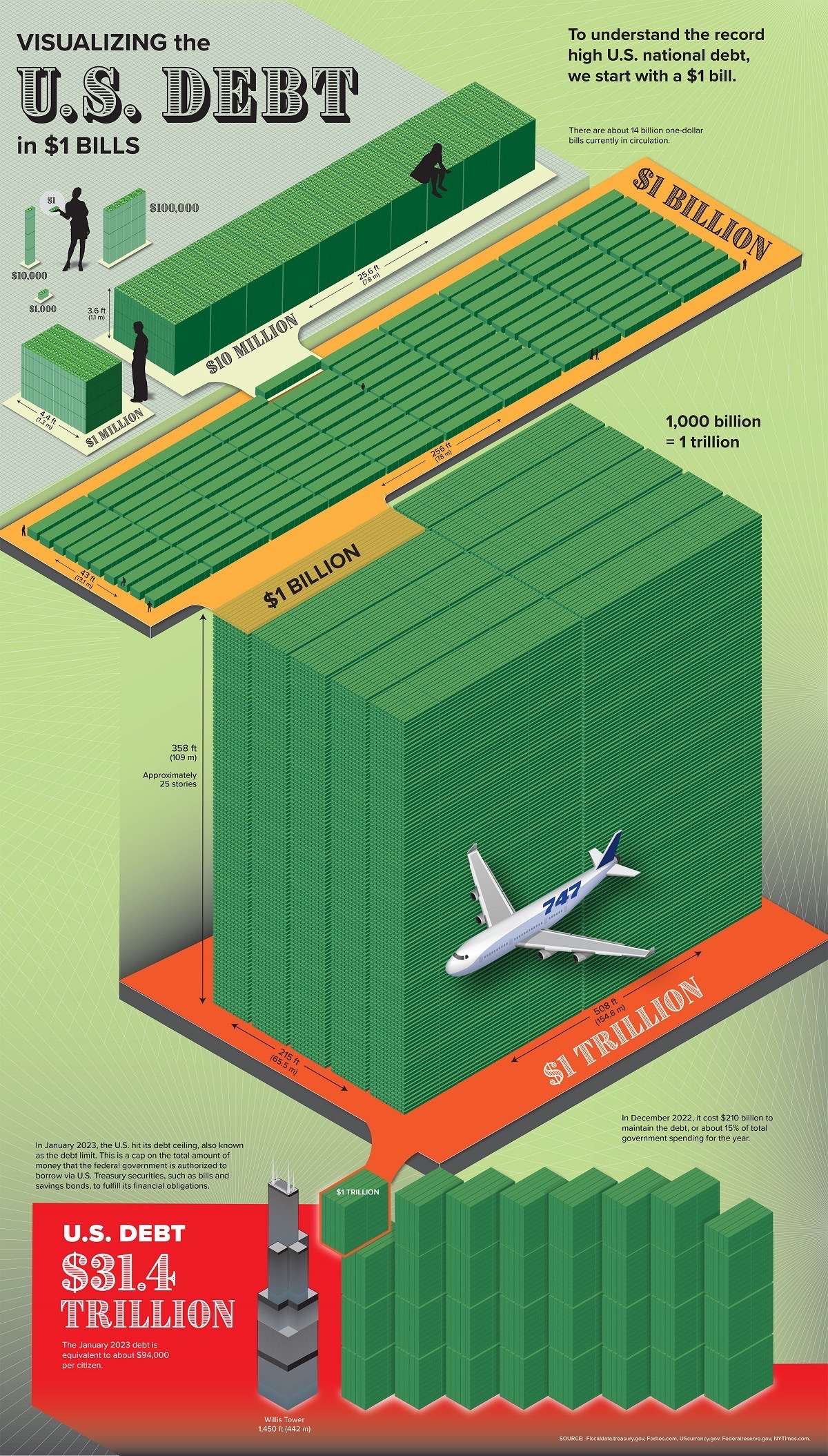
Over the last decade, Congress authorised trillions of dollars in spending, and the United States’ debt has nearly tripled since 2009. By April 2023, US debt had reached roughly $31.4 trillion, equivalent to around 126% of GDP. Large numbers, admittedly. The sort of numbers that make financial headlines sound particularly dramatic over breakfast.
For comparison, the European Union’s debt sits around 91% of GDP, the UAE’s around 38%, and Australia’s roughly 35%. Japan remains the true overachiever in this department, with debt levels exceeding 237% of GDP. Yet despite carrying the world’s highest debt-to-GDP ratio, Japan has never defaulted. This rather complicates the simple “high debt equals catastrophe” narrative that financial television enjoys so much.
Still, the United States clearly spends more than it collects in revenue. If the government were ever unable to borrow additional money, payments would eventually start drying up. Military salaries, retirement payments, social benefits, and interest payments on debt could all come under pressure. And once markets begin doubting whether a government can comfortably meet its obligations, borrowing costs rise very quickly. Investors dislike uncertainty almost as much as they dislike missing a market rally
One interesting question rarely discussed during a US Debt Ceiling Crisis is whether other countries operate under similar systems. In reality, very few do. Most governments avoid fixed debt ceilings because they tend to become political bargaining tools rather than effective fiscal discipline. Countries that impose borrowing limits usually tie them to GDP percentages rather than choosing an arbitrary nominal figure.
Denmark is one of the only countries with a debt ceiling resembling the American system, although the Danes solved the problem rather elegantly by setting the limit high enough to avoid constant political drama. Australia briefly experimented with a debt ceiling in 2008, only to abandon it in 2013 after discovering it had become a reliable source of endless political bickering.
Which, unfortunately, is precisely where the American debt ceiling now seems to live permanently: somewhere between economic policy, political theatre, and a recurring event designed to impact smart investment decisions worldwide
When the clock ticks
Raising or suspending the debt ceiling becomes necessary whenever the government needs to borrow more money to pay obligations already approved by Congress. For most of the past century, increasing the limit was considered fairly routine. Not exactly thrilling political material, admittedly, but also not something capable of terrifying global investors before breakfast.
Congress can either raise the ceiling outright or temporarily suspend it, allowing the Treasury to continue borrowing beyond the limit for a certain period. Since 2013 alone, the debt ceiling has been suspended seven times.
Things became far more dramatic after 2011, when debt ceiling negotiations transformed into a highly charged political football. Heated battles between Democrats and Republicans created a lengthy deadlock, and the debt ceiling was eventually raised only two days before the Treasury was expected to run out of money. Naturally, global markets reacted with all the composure of a champagne glass balanced on a moving yacht.
The political brinkmanship triggered one of the most volatile weeks in global stock markets, and for the first time ever, the United States lost its AAA credit rating. Even worse, the delay increased US borrowing costs by an estimated $1.3 billion in 2011 alone.
The pattern repeated itself in 2013, when endless negotiations forced the government into a shutdown, and again in 2021 when the country drifted uncomfortably close to economic trouble. In the end, Democrats raised the ceiling without Republican support because they still controlled Congress. The ripples, however, were felt far beyond Washington, once again starting to impact smart investment decisions and global financial markets.
And now, for the first time during a modern US Debt Ceiling Crisis, economists are openly discussing the once unthinkable possibility of a US default. Which, understandably, tends to make investors slightly uneasy.
Speed Read
The debt ceiling was introduced at a time when Congress was far more involved in the practical business of borrowing money.
Until 1917, financial administration was complicated household bookkeeping by Congress
Since 1939, the national debt has grown rather dramatically. By April 2023, US debt is around 126% of GDP.
Broadly speaking, if the US government hits the debt ceiling, it will run out of money soon after and temporarily default on its obligations.
In 2011, the weeks-long negotiations were among the most volatile in global stock markets. Moody downgraded the US from AAA to AA.
The 2023 US debt ceiling crisis rocks global investing, creating uncertainty because, for the first time, a US default is discussed.
In the unlikely event of the US defaulting, consumer confidence would drop, shocking financial markets and tipping the global economy into recession.
The resulting stock market sell-off would erase trillions of US Dollars in global wealth.
This would result in a debt crisis in emerging markets.
If investors don’t trust the U.S. government to pay its debts, the system will be considered broken.
However, neither side has any interest in the US defaulting on its debt.
The short-term lending markets could grind to a halt. Similar to the beginning of the global financial crisis 2008.
The US Dollar would lose its status as the world´s anchor asset, which could persuade other countries to adopt other currencies as their reserve currencies.
High stakes ahead
If the Treasury Secretary is correct, there are just a few precious weeks remaining for Congress and the White House to reach a debt-limit accord. Or else this might end in “an economic and financial catastrophe.”
The fact is without a sustainable compromise, US finance will fall off the cliff by June 1st.
Sadly this time, the differences between Congress and the US administration seem to be unbreachable. Republicans want spending cuts tied to lifting the debt limit. Democrats insist on a “clean” bill with budget discussions to follow. The chances for a quick fix are very low.
However, let’s bear in mind that neither side can have any interest in the US defaulting on its debt.
Wacky 11th-hour solutions
Some “experts” have come up with alternative solutions.
“Failure to meet the government’s obligations would cause irreparable harm to the U.S. economy, the livelihoods of all Americans and global financial stability,”
Janet Yellen, Treasury Secretary since 2021; former Federal Reserve Chairwoman
The potential repercussions
The failure to find a solution would result in a downgrade by credit rating agencies. Thus, increasing borrowing costs for businesses and homeowners alike. Consumer confidence would drop, which could shock financial markets and tip the global economy into recession. Goldman Sachs economists have estimated that a breach of the debt ceiling would immediately halt about one-tenth of U.S. economic activity.
According to centre-left think tank Third Way, a breach that leads to default could cause the loss of three million jobs in the US. Mortgages would spike. Rising interest rates would increase the US national debt by $850 billion.
Even a prolonged standoff could result in something a lot worse than what happened in 2011 or 2013. Why? Short-term loans are often backed-up with US Treasuries as collateral. If the U.S. defaults on some of its bonds, lenders may be unwilling to accept those tainted securities as collateral.
Worse, Wall Street’s trading systems have not been set up to separate defaulted Treasuries from the rest. Because few thought a U.S. default was ever possible. This could lead to the short-term lending market grinding to a halt. Similar to the beginning of the global financial crisis.
Global jitters and the impact on investing
An estimate from Moody’s Analytics predicted that the U.S. would slide into recession in a prolonged default scenario. The Gross Domestic Product would fall by almost 4%, and some six million jobs would be lost. The resulting stock market sell-off would erase $15 trillion in US household wealth and impact smart investment decisions around the globe, wiping out many more trillions. The recipe for yet another global recession. In the short term, interest rates would spike. In the long term, they would never fall back to pre-default lows.
The worlds anchor asset
Experts say a U.S. default could wreak havoc on global financial markets. The creditworthiness of U.S. treasury securities has long bolstered demand for U.S. dollars. It has the status of the world’s reserve currency. Any hit to confidence in the U.S. economy could cause investors to sell U.S. treasury bonds and thus weaken the dollar.
Securities issued by the U.S. have been treated as essentially risk-free. Dollar denominations underpin a vast number of financial contracts worldwide.
The stability of the dollar has made it the dominant global reserve currency since the end of World War II. This has generated constant global demand for dollars, making it possible for the U.S. government to borrow at lower interest rates than other large nations.
The decrease in the US dollar’s value causes the value of many reserves to drop. This could send ripples through the global treasury markets.
“If it turns out that that asset is not actually risk free, but that it can actually default, that would basically detonate a bomb in the middle of the global financial system. And that will be extremely messy.”
Jacob Kirgegaard, Senior Fellow, Peterson Institute for International Economics
The U.S. dollar is a common currency in much of the world. Some countries have adopted the dollar as the official currency. Often, it exists side-by-side with a local currency that is often “pegged” to the dollar to keep its value stable.
Heavily indebted low-income countries holding dollar reserves would struggle to meet interest payments on debt denominated in other currencies. This could result in a debt crisis in emerging markets.
Global trade
Around the globe, many cross-border transactions carry requirements that are settled in U.S. dollars. This is seen as a practical way to be sure that sudden swings in the value of a local currency don’t dramatically disadvantage one party in a transaction that is to be settled in the future.
A sudden and sharp decline in the dollar’s value would mean that individuals and companies anticipating payment on existing contracts in dollars would effectively receive less than they had expected for their goods and services.
In addition, if a default drove the U.S. into recession, U.S. consumers and businesses would reduce the number of goods and services they purchase from outside the country.
While this would affect virtually all countries to some extent, emerging market countries that rely on exports to the United States for much of their income would be particularly hard hit.
The expected devaluation of the dollar would have a similar impact. It would make it more expensive for U.S. firms to purchase supplies overseas, reducing trade even further.
Capital flow
One of the economic advantages the United States has long enjoyed is that it is a magnet for global capital. When the global economy is strong, invest in U.S. firms. When times are bad, investors seek shelter in U.S. Treasuries. Either way, global markets are directing capital into the U.S.
If investors don’t trust the U.S. government to pay its debts, interest rates go up for the wrong reason. The system will be considered broken.
Thus investors seeking shelter would be more cautious about assuming that Treasury securities are the go-to investment to protect their assets. Investors would begin to direct at least some of their investments to securities issued by other governments and denominated in different currencies.
A new reserve currency
The Dollar instability could benefit the Euro Zone or aspiring power rivals such as China.
For years allies like the European Union and competitors like China have suggested that it would be better if the dollar’s dominance were not as complete as it is.
So far, there has been little movement to unseat the dollar in recent decades. Still, a shock like a default on U.S. debt could persuade some countries to hedge their bets by adopting other currencies, such as the Euro or Renminbi, as additions to their reserve holdings.
So… Is Financial Civilisation Ending Again?
Probably not. Nervous? Perhaps a little. Completely paralysed by financial headlines predicting the global economy going to hell in a handbasket? I hope not!
The reality is that a US Debt Ceiling Crisis matters because the United States sits at the centre of global finance, investment flows, and reserve currencies. Political deadlock in Washington can rattle markets, unsettle investors, weaken confidence, and certainly impact smart investment decisions around the world. Yet history also shows that these crises tend to follow a familiar pattern: dramatic headlines, increasingly theatrical negotiations, market jitters, and finally a last-minute agreement that allows everyone to declare victory. And the financial markets? They tend to bounce back in no time, with the bad eggs gone and risk-prone investors licking their wounds.
The most intelligent approach is neither blind optimism nor apocalyptic panic. Stay informed. Stay curious. Ask questions. Understand the facts. And remember: financial markets have survived wars, crashes, bubbles, recessions, political chaos, and generations of economists confidently predicting catastrophe. Financial markets, for reasons nobody fully understands, keep going back to business as usual.
So perhaps it would be a smart investment decision to seek opportunities amidst challenges. Keep a cool head, navigate wisely, and think long-term to succeed in the long term.
VERDICT: stay positive but vigilant
The US debt ceiling crisis is certainly a wake-up call for global investors, especially for high-risk takers. It highlights the need for vigilance, diversification, and a deep understanding of the interconnectedness of financial markets. By staying informed and adapting strategies, investors can navigate these uncertain times and position themselves for long-term success.
Stabilise the portfolio. Seek opportunities. Stay informed. Navigate wisely.
A final note before you leave:
Cut through the nonsense – and you got this!
– Yours, Harper