Inverted Yield Curve: Nervous Markets. Gloomy Experts.
–The Facts–
A Financial Market Warning Sign Worth Noticing, Or Just Scaremongering?
My dear Friends,
how are you faring with all those scaremongering headlines about a looming recession? Over the past few weeks, nervous markets have resulted in a steady stream of gloomy predictions, anxious commentators, and enough economic doom to make one wonder whether the global economy is once again preparing for the “worst” recession in history.
The latest source of concern is something called an inverted yield curve. Headlines have been quick to declare it a worrying signal, while gloomy experts are busily explaining why we should all be paying attention. Recession warnings, market jitters, and increasingly solemn forecasts have followed close behind.
However, before we all succumb to panic mode, we should first find out what this inverted yield curve is all about and why some financial experts are waving the red flag.
Is the concern justified—or simply another chapter in the financial industry’s love affair with alarming headlines?
What Are Bonds
Before we can tackle the mystery of the inverted yield curve, we take a quick detour and look at what bonds actually are. Don’t worry, this is far less painful than it sounds
Generally, a bond is a loan from an investor to a borrower, such as a company or government. Bonds are a way for governments and companies to raise money. Imagine lending money to a friend who promises to pay you a fixed amount of interest each year and to return the original amount on an agreed date.
A bond works much the same way, only with considerably more paperwork.
In return for providing the money, you receive regular interest payments. This is why bonds have long been popular with people seeking a steadier, more predictable source of income than shares can usually provide. However, like stocks, a bond’s market value can change over time.
Most diversified portfolios contain a mix of shares, bonds, gold and cash. Bonds are fixed-income instruments; they provide stability and a steady flow of income, and are one of a portfolio’s three main asset classes. They may not generate the same excitement as a soaring stock market, but when nervous markets make headlines and gloomy experts begin forecasting a stock market crash, bonds often become the safer bet.
Types of bonds
Like most things in finance, bonds involve a trade-off between risk and reward. Generally speaking, the safer the bond, the lower the interest it pays. The greater the risk, the higher the potential return. Financial markets, rather annoyingly, rarely offer both excitement and complete safety at the same time.
Government Bonds
Government bonds are issued by national governments to help pay for public spending. When you buy a government bond, you are effectively allowing a government to use your money for a period of time in exchange for regular interest payments.
To help investors assess risk, governments receive credit ratings, much like a financial report card. The higher the rating, the more confidence investors have that the government will repay its obligations. The downside? Safety tends to come at a price. Government bonds usually offer lower interest payments than riskier alternatives.
Governments issue bonds with different maturities, ranging from a few months to several decades. As we shall see later, those different maturities play an important role in understanding the mysterious inverted yield curve.
Corporate Bonds
Companies can issue corporate bonds when they need to raise money. A little bit like selling stocks. But unlike stocks, bonds don’t give you ownership rights. They represent a loan from the buyer (investor) to the bond issuer(company).
Usually, companies issue bonds when they want to build a new plant, for example. Then the company issues a bond with a fixed maturity date. In short, the period the company needs the investor’s money to complete the project successfully. Once the investor has bought the bond, she/he will receive interest for the amount the investor has “lent” to the company. At the end of the “loan period”-the maturity, the company will pay back the amount it “borrowed”.
As with government bonds, bonds can be either high-yield or investment grade. A company usually issues a high-yield bond with a higher risk of default. Yet, companies that issue investment-grade bonds usually have a higher credit rating/lower risk of defaulting and, therefore, only need to pay lower interest rates.
The yield curve
This is usually the point where financial articles become unnecessarily complicated. Stay with me because the yield curve is actually much simpler than its reputation suggests.
Many people assume that all bonds pay roughly the same interest rate. In reality, the interest paid often varies with how long the money is tied up. A bond lasting two years may pay a very different rate from one lasting ten or thirty years. The yield curve is simply a way of visualising those differences.
More importantly, the yield curve offers a glimpse into what financial markets expect to happen in the future. It reflects the collective mood of investors, their confidence in the economy, and their expectations about growth, inflation, and risk. Think of it as a financial weather forecast. Not always perfect, but often useful.
This is why, by nature, the gloomy expert has a fixation with the yield curve. A normal yield curve usually suggests confidence about the future. An inverted yield curve, however, tends to attract headlines, recession forecasts, and a remarkable amount of hand-wringing.
The normal yield curve
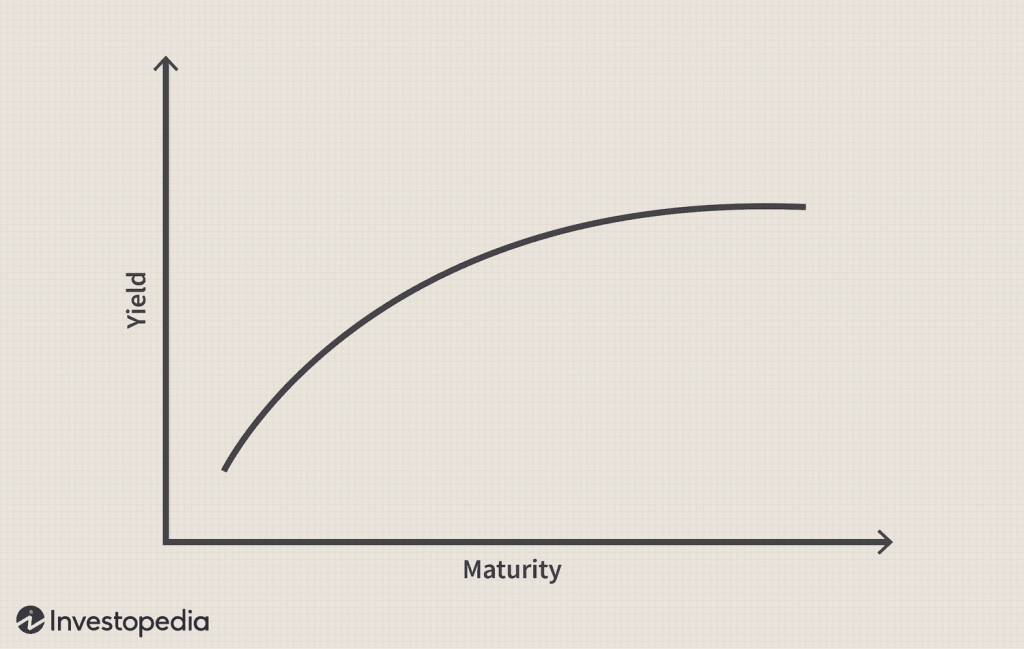
A normal yield curve reflects a fairly straightforward idea: the longer you agree to leave your money invested, the greater the reward you expect in return.
Lending money to whoever, for one year, is OK for most of us. Lending it for ten or twenty years is another matter entirely. A lot can happen over time, and investors generally expect to be compensated for taking on that additional uncertainty.
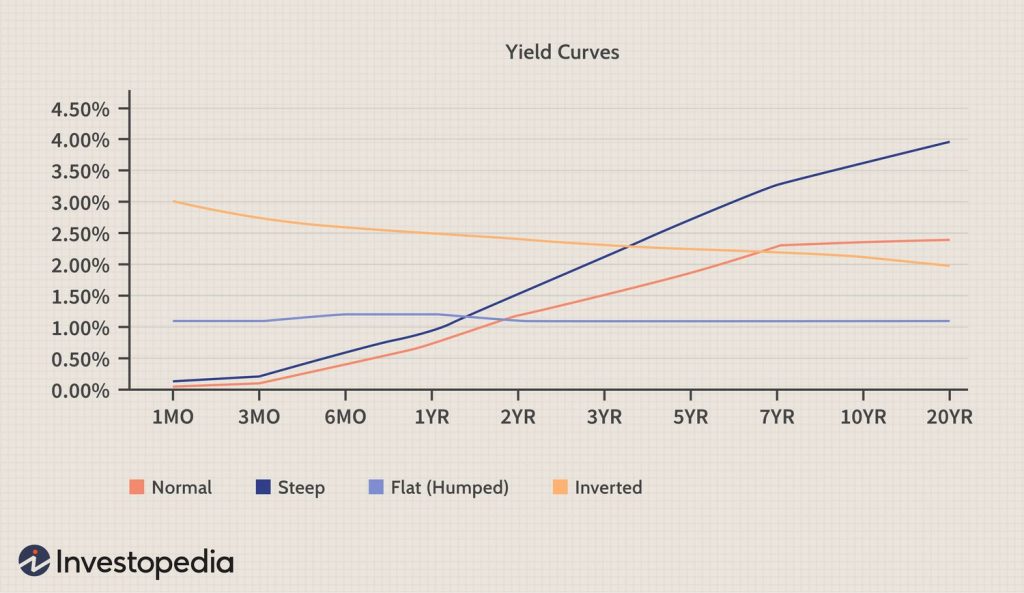
This is why short-term bonds usually pay lower interest rates than long-term bonds. On a graph, this creates an upward-sloping yield curve, with yields gradually rising as maturities lengthen.
In simple terms, a normal yield curve suggests that investors expect the economy to continue growing at a reasonably healthy pace, without major disruptions, runaway inflation, or financial drama.
The steep curve
A steep yield curve usually appears when an economy starts recovering after an economic stagnation. Short-term interest rates are still low because growth has been sluggish, but investors are beginning to expect better times ahead.
As the economy improves, companies and governments often need more money to invest, expand, or rebuild. That rising demand for money can also raise fears of inflation.
Long-term bond investors then become more cautious. If they agree to lock their money away for many years, they do not want to be stuck with low interest while prices rise around them. So they ask for higher rates in return.
In plain English, a steep yield curve often says, “the economy may be waking up, but investors want to be paid properly for waiting.”
Inverted yield curve
An inverted yield curve looks rather odd because it reverses the normal relationship. Instead of demanding higher rewards for tying up their money for longer periods, investors suddenly seem willing to accept lower returns on long-term bonds.
Why would they do that?
When concerns about slower growth, economic trouble, or even a recession start spreading, many investors rush into long-term government bonds, which are generally considered safer places to park money during uncertain times.
As more people buy these long-term bonds, their prices rise, and their yields fall. At the same time, demand for shorter-term bonds weakens, causing their yields to move higher. Eventually, the normal yield curve inverts.
This unusual pattern is one reason nervous markets and gloomy experts pay such close attention to the inverted yield curve.
Flat or humped curve
Before an inverted yield curve appears, the yield curve usually goes through an awkward middle phase. Short-term and long-term interest rates begin moving closer together until there is very little difference between them. On a graph, the curve appears flat, or sometimes slightly raised in the middle, forming a gentle hump.
A flat or humped -shaped yield curve does not automatically mean a recession is around the corner. Many never progress any further. However, it is often a sign that investors are becoming more cautious about the future and less convinced that strong economic growth will continue indefinitely.
This is usually the point where investors start asking more questions, and gloomy experts begin appearing on financial television with increasingly serious expressions. Periods of flattening yields have often been followed by slower economic growth and lower interest rates. Not a reason to panic, but certainly a reason to pay attention.
The Buzz
A bond is a loan from someone who has money to an entity that needs money, such as a company or government
Short-term bonds pay lower interest rates than long-term bonds
A yield curve is simply a way of visualising the interest rate difference between long and short-term bonds
A normal yield curve reflects investors’ trust in the market
The inverted yield curve signals that risk-averse investors turn to long-term bonds with lower returns
With increased demand for long-term bonds, their prices rise, and their yields fall
A decline in demand for shorter-term bonds causes their yields to rise
A yield curve is simply a financial market mood indicator
The shape of a national bank´s bond yield curve offers clues about the state of a country´s economy
The US Treasuries´yield curve is widely regarded as a global benchmark
An inverted yield curve does not always mean recession. Sometimes, it points to a slowdown
Downturns do not last forever, and excessive risk aversion can do damage too
Reading a yield curve
A yield curve is simply a visual snapshot of the interest rates available on bonds with different maturity dates. In other words, it shows how much investors expect to earn on their money over different periods, from a few months to several decades.
The shape of the yield curve changes across economic cycles, so many investors, wealth managers, and economists watch it closely. Think of it as a financial market mood indicator. It reflects how investors feel about the economy today and what they expect might happen tomorrow.
In an ideal world, the yield curve slopes gently upward, suggesting confidence in future economic growth. However, the curve does not always behave as expected. Sometimes it flattens, sometimes it steepens, and occasionally it turns upside down altogether.
When an inverted yield curve appears, long-term returns fall below short-term returns. This unusual pattern has historically been associated with economic slowdowns.
Tell tales of a curve
- Forecasting interest rates: The shape of the yield curve provides investors with insight into the future course of interest rates. A normal upward-sloping curve usually means that longer-term bonds pay higher interest. An inverted yield curve, however, means short-term bonds suddenly pay more than long-term bonds, which is why people start raising eyebrows
- Forecasting the banking business:
Banks usually make money by paying lower interest on short-term deposits and charging higher interest on longer-term loans. When the yield curve is steep, that difference can be quite profitable. When the curve flattens or inverts, that gap shrinks, typically leading to lower profits for financial intermediaries. - Forecasting economic developments: The normal yield curve is often viewed as a useful indicator of where the economy may be heading. An upward-sloping curve is generally associated with a growing economy and confidence about the future. An inverted yield curve, on the other hand, suggests that investors are becoming more cautious and may be expecting slower economic growth ahead. Primetime for the gloomy expert.
The influencing factors
- Inflation: One thing everyone watches closely is inflation. When prices rise too quickly, the purchasing power of money falls. Put differently, the same amount of money buys less than it did before. To slow inflation down, central banks often raise interest rates. As a result, consumers, investors and the gloomy expert alike are paying close attention to where rates may be heading next.
- Economic growth: Strong economic growth is usually good news, but it can also create new challenges. When businesses expand, consumers spend more, and investment activity increases, demand for money rises as well. This can push inflation higher and increase competition for capital. Investors, therefore, expect higher returns for tying up their money for longer periods, which often results in a steep yield curve.
- Central bank interest rates: When a central bank raises interest rates, government bonds can become more attractive because they may offer better returns. As more investors buy those bonds, bond prices can rise, and yields may fall again. Yes, finance has a talent for making one thing move just as another thing moves in the opposite direction. Super confusing!
So, What Is The Fuss All About?
As explained, the shape of a national bank´s bond yield curve can offer useful clues about the current state of a country´s economy and where it may be heading next. The US Treasury yield curve occupies a special place because it is widely regarded as the benchmark for both the US and, to a large extent, the global economy.
Government bonds and other government-issued securities are generally considered among the safest investments available because they are backed by the issuing government. As a result, they usually pay lower yields than riskier investments, such as corporate bonds. This allows investors to compare the returns on government bonds with those on corporate bonds.
The difference between the two is known as the “spread”. The smaller the spread, the more comfortable investors are with taking additional risk. The larger the spread, the more cautious they become. Historically, spreads tend to widen during recessions and narrow again as economic conditions improve.
How Did We End Up Here?
The sharp sell-off on Wall Street, triggered by rising interest rates, pushed many investors towards longer-term government bonds. In uncertain times, investors often prefer the perceived safety of this asset class, even if the returns are less exciting.
As demand for long-term bonds increased, their prices rose, and their yields fell. Et voila, here it is, the inverted yield curve.
In simple terms, investors became increasingly concerned about a possible recession and were willing to lock in long-term U.S. government bond yields rather than increase investor uncertainty elsewhere.
This matters because history shows that an inverted yield curve has preceded every US recession over the past four decades.
Nervous Markets. Gloomy Experts – Should Investors Be Spooked?
In a globalised world, recession fears in the United States matter. The US is still the world’s largest economy, so when investors start worrying there, the rest of the world tends to listen, whether invited or not.
However, the picture is not all gloom. US economic data still looks relatively strong, unemployment is at its lowest level in decades, and the economy remains resilient. It is also worth remembering that an inverted yield curve does not always lead to a full recession. Sometimes, it points to a slowdown instead.
That distinction matters. A slowdown can affect different asset classes, but usually with less force than a full recession. Historically, slowdowns have often preceded recessions, but they have not always led to one.
So, no, this is not a cue to panic beautifully into poor decisions. Downturns do not last forever, and excessive risk aversion can do damage too. If investors become too cautious at the wrong moment, they may miss out on returns that matter to their long-term financial interests.
The Verdict: Do not panic, its Just A Financial Market Weather Forecast
An inverted yield curve can signal an economic slowdown, which is not the same as a recession. Remember: slowdowns usually do not last forever. So, do relax and think about your long-term financial goals. Excessive risk aversion can do damage, too.
Something to ponder about:
Compounding works on money and on indifference—you choose!